ShopDreamUp AI ArtDreamUp
Deviation Actions


Suggested Deviants


Suggested Collections


You Might Like…


Featured in Groups

Description
More of my artistic speculations on planetary landscapes can be seen in my DA "Scientific Illustration" gallery:
[link]
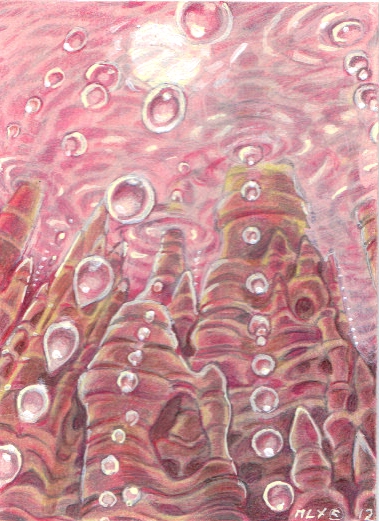
This might be referred to a "Soda Pop World". It is a planet close to one earth mass. It orbits a slightly cooler K Class star than our home world. It is covered in oceans but they are not made of water. The surface is inundated in liquid fluorocarbon. Humans could actually dive in this compound so long as they were equiped with a source of oxygen.
The structures rising from the sea bed that resemble Watts Towers are forms that grow by percipitating carbonates and other compounds from out of solution. The banding about them suggests that they are rythmites keyed to the solar tides. Some very complex chemistry is going on in this warm sea. I leave it to speculation as to whether there are biological factors involved with this growth in the manner of Earthly stromatolites.
art & text (c) John P. Alexander
[link]
This might be referred to a "Soda Pop World". It is a planet close to one earth mass. It orbits a slightly cooler K Class star than our home world. It is covered in oceans but they are not made of water. The surface is inundated in liquid fluorocarbon. Humans could actually dive in this compound so long as they were equiped with a source of oxygen.
The structures rising from the sea bed that resemble Watts Towers are forms that grow by percipitating carbonates and other compounds from out of solution. The banding about them suggests that they are rythmites keyed to the solar tides. Some very complex chemistry is going on in this warm sea. I leave it to speculation as to whether there are biological factors involved with this growth in the manner of Earthly stromatolites.
art & text (c) John P. Alexander
Image size
379x521px 139.25 KB
© 2012 - 2024 LEXLOTHOR
Comments4
Join the community to add your comment. Already a deviant? Log In

Very nice picture, not too sure about the backstory, tho.